Aiken Pickleball News

More unusual situations that occur while playing pickleball and how they should be handled.

SITUATION: Neither player on Team A clearly saw whether a ball landed out on their side of the net and requested the opinion of nearby spectators, who said the ball was out. Team B asserted that, if Team A was unsure, the ball should be considered “in” and it is illegal to ask spectators.

QUESTION: Was Team B’s assertion correct?

ANSWER: Yes. The opponent gets the benefit of the doubt on line calls made. When doubt exists, Team A’s call will be “in” (Rule 6.D.3. & 9). Spectators should never be consulted on any line call (Rule 6.D.4).


SITUATION: A doubles match was being played in a gym with many other courts also in play.  During play, a Team B player heard someone on another court shout “PICKLE!” (loose ball) and stopped playing, missing a shot. The player claimed a hinder, even though the loose ball was not on their court.

QUESTION: Was the hinder claim legitimate?

ANSWER:  Yes. Gymnasium play can be very noisy, and such “pickle” calls can be especially distracting. A hinder is any element or occurrence outside of the player’s control that impacts play (Rule 3.A.15). A hinder called by a player will result in a dead ball and will result in a replay (Rule 8.C.).


SITUATION: A Team A serve touches the net, but was otherwise good and landed in the service court so a “let” was called. The next serve was also a let.  Team B claimed a fault on the server asserting only one service let is allowed.

QUESTION: Was Team B’s claim legitimate?

ANSWER: No. There is no limit to the number of lets a server may serve (Rule 4.0).


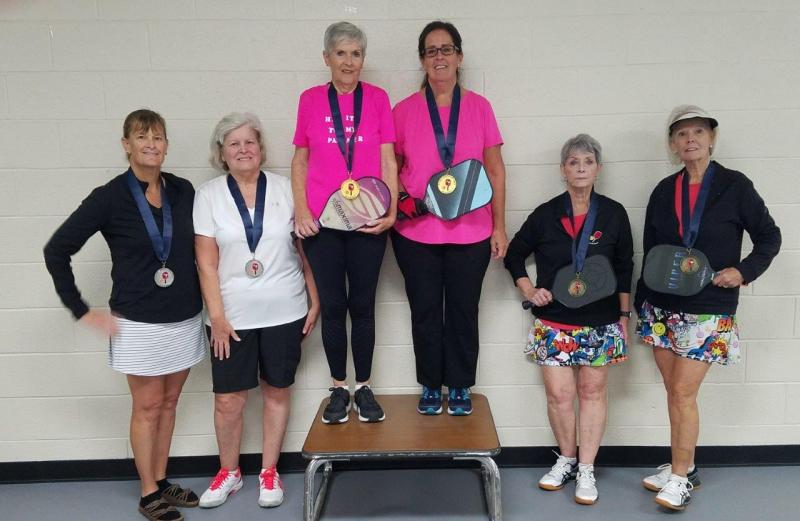
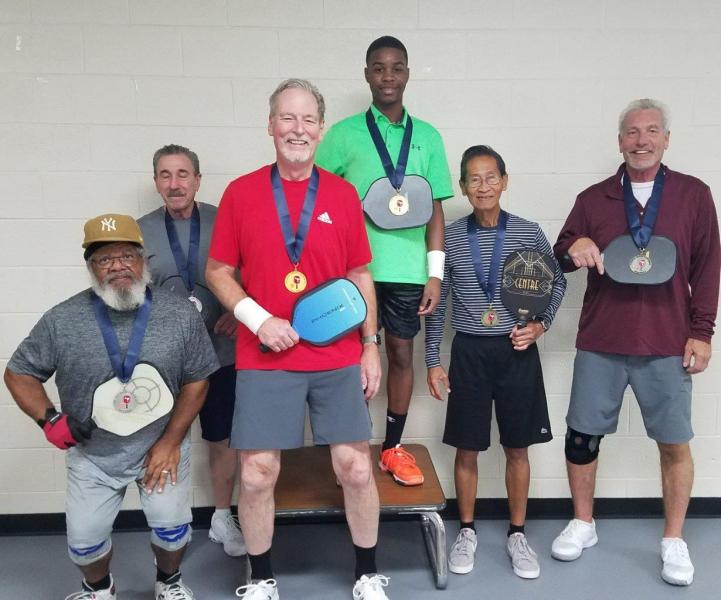
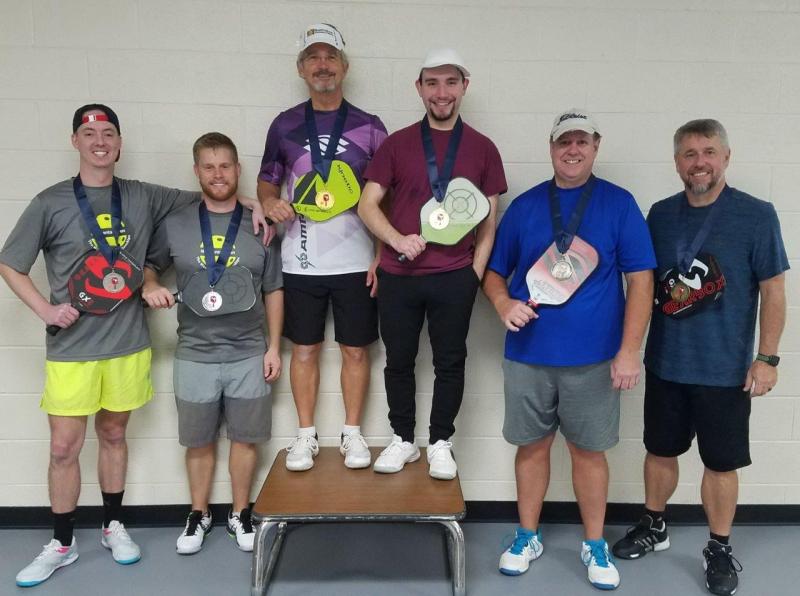
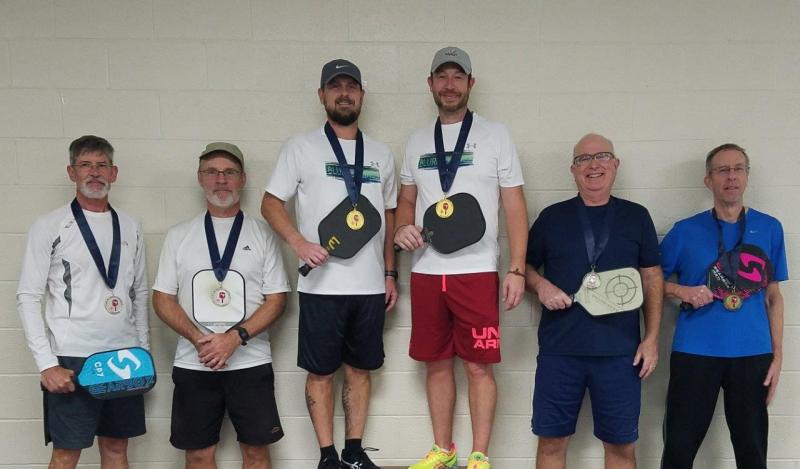
We have updated the rating process for Court Designation Play.  Changes include 1) Once a player has been rated there is a four-month waiting period before they can be rated again;   2) Players who win gold medals at the Aiken yearly tournament will no longer be considered for an upgrade to the next higher skill level. 

For a complete look at all the changes go to Odell Weeks Guidelines under the Information tab.


Last Saturday at First Presbyterian Church, after all play was completed, there were two metal water bottles and a pair of glasses left behind.  All three items are now in the room where the nets are kept,  on a shelf on the wood podium next to the door.  The room can be accessed next Saturday morning after 9am.  

If you need the items before then, you can try calling 1st Pres  (803) 648-2662 and ask for assistance in retrieving your item.  


We got off to a great start for 2020 at  First Presbyterian Church this Saturday morning January 4th.  Twenty-four (24) people had signed up and a few players showed up who hadn’t signed up but people were courteous and patiently sat and waited for their turns to play.

To help with play next week, Saturday, January 11th, there will be two sessions.  One will be from 9-11am and the other from 11am-1pm, with a limit of eighteen (18) players per session.  Sign-up is required. You can only sign up for one session per Saturday.

Special note:  Please put your names on your paddles.  Those little return address mailing labels work great!  Also, we had a couple of water bottles left today after everyone was gone.  It would help if you could put your names on these so we can get them back to their proper owners.

Thanks to everyone for being so patient.  Hopefully having two sessions next week will make play more enjoyable.   And special thanks to Michele Bullington and Dick Keeler for opening and closing. 

January 11th will be the last day of indoor play at 1st Pres on Saturdays until February 1st.  


SITUATION: In a tournament match, a Team A player wore a shirt which was a color similar to the ball. Team B requested that the Team A player change his shirt. Alternatively, Team B requested the match use a different color ball.

QUESTION: Were either of Team B’s requests required to be satisfied?

ANSWER: No. The referee determined that the player’s shirt color did not present a sufficient safety or distraction issue. (Rule 2.G.1) Further, the tournament announcement clearly described what color balls would be used during the tournament, so changing the ball was not required.  However as a courtesy, the referee offered use of a different color ball, only if all players agreed. The players chose to play with the original ball.

And just for the record, the Super Senior Round Robin being held on Saturday, January 18th, will be using an Onix orange ball - so please no orange tee shirts!


There will be indoor play on Saturdays at First Presbyterian Church, January 4th & 11th, from 9am - 1pm.  Need a minimum of four players to sign up, or the sessions will be cancelled.

 First Presbyterian Church is located at 224 Barnwell Avenue, NW in downtown Aiken.  Please park on Barnwell Avenue and go in the door by the Coke machine. Turn right after you go in and go through the double doors into the gym.  There is a $2.00 per person fee for each session.  A container will be placed in the laundry room where the nets are stored.  All of these funds will go directly to the church as a donation to help them cover the costs of heating and air conditioning, and general wear and tear on the gym.  


Click here for a video that will help you understand some of the most common mistakes that beginner pickleball players make and how to fix them! 


Here are some rule interpreta- tions concerning serving that you might find useful.

SITUATION:  A server on Team A called the score but before beginning her service motion, the receiver on Team B called a time-out. Team A claimed Team B committed a fault because a receiver may not become “un-ready” after the score has been called.

QUESTION:  Did the receiver on Team B commit a fault?

ANSWER: No.  It’s generally true that a receiver may not become “un-ready” after the score is called (Rule 4.C.2), however, there are a few things which may occur after the score is called but before service motion begins. One such thing is any player may call a time-out before the service motion has begun (Rule 4.D.2).

QUESTION: Can a server tap the ball with their paddle after the score has been called? I have a partner who taps 2 times as part of his serve routine. We are playing in a tournament in a few weeks and want to make sure it is a legal serve.

ANSWER: Of course, he can. And as you are describing it, the taps are before your partner starts his service motion, so there is no problem.

QUESTION:  After announcing the score, is it legal to do a practice swing before actually serving the ball?

ANSWER: The server is not allowed to take a practice swing or fake a serve. Unless a hinder has occurred to cause the server to not contact the ball, the referee will call a service fault (USAPA Casebook for Referees).


Be a part of the exciting future of pickleball.  The USAPA’s membership is comprised of people who, just like you, share a passion for our great game!   When you join the USAPA, you receive exclusive benefits for your membership.  

Some of the benefits include

Click here for more information and how to become a member.

Below are the number of USAPA memberships by Region - a little over 40,000.  Our region - Mid-Atlantic - ranks 3rd out of 11 regions!

Atlantic  - Participant Count: 2351

Atlantic South - Participant Count: 5413

Great Lakes - Participant Count: 3523

Great Plains - Participant Count: 2392

Mid-Atlantic - Participant Count: 5342

Mid-South - Participant Count: 3281

Middle States - Participant Count: 2568

Mountain - Participant Count: 1766

Pacific NW - Participant Count: 4441

Southwest - Participant Count: 4589

West - Participant Count: 5533


Recently two female pickleball players were approached by a panhandler asking for money as they were entering their cars in the Smith-Hazel parking lot.   They indicated they had no money, that they were there playing pickleball. They then entered their cars and left the lot.  The Smith-Hazel staff have been alerted about the incident. This could happen anywhere at anytime, so stay alert out there.  If at all possible, players should not leave alone but should go at least in pairs.


Pages